American Gestapo
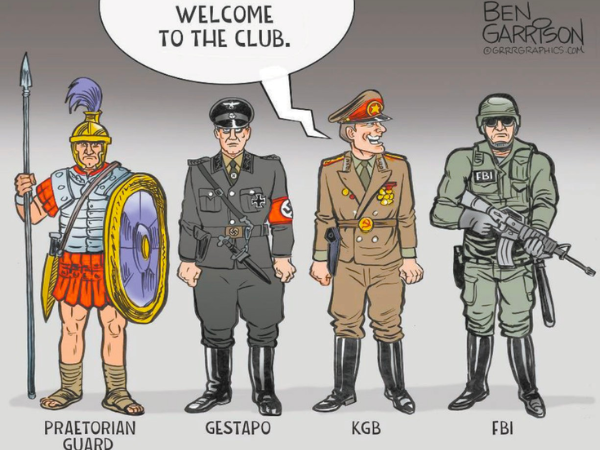
FBI Is the American Stasi, Gestapo, and KGB.
By John Livingston
December 17, 2024
Patriot Whistleblower Calls Out FBI’s ‘Politicized Agenda’ And Sweeping Surveillance of Citzens
Once the crown jewel of American law enforcement, the FBI has discovered itself in shambles. Public trust in the Bureau has plunged, thanks to several scandals that have made it look more like a political weapon than a neutral agency.
The organized crime syndicate masquerading as the Democratic UniParty has managed
during the 12 years of the Obama and Biden regimes to turn the FBI, along with the rest of the federal bureaucracy, into organizations dedicated to the preservation of the crime syndicate and the enrichment
of its bosses and the plundering of its foes, primarily the American middle class.
From secretly examining Donald Trump during his very first term to disregarding the Biden household’s alleged crimes, the FBI has lost the confidence of the very people it’s expected to secure.
And who could forget the shocking raid on Trump’s Mar-a-Lago estate in 2022? It was an extraordinary operation that made the Bureau appear less like protectors of justice and more like henchmen for the ruling celebration.
American Gestapo
The general public’s understanding of the FBI has sharply shifted, prompting widespread shock and indignation. What was when a revered institution understood for removing notorious crime lords now appears to be focused on pursuing law-abiding people with conservative views?
Insiders have spoken up, exposing a troubling trend in which partisan interests are focused on overriding essential freedoms. To many, the FBI has failed in its responsibilities and threatened the extreme principles it is supposed to promote.
American Gestapo
With FBI Director Christopher Wray poised to step down after nearly a decade in office, critics have fueled concerns about the agency’s impartiality. The President-elect bureau has revealed a prejudiced approach to examining domestic terrorism and civil liberties cases.
While Wray, who Trump designated in his very first term on recommendation of former NJ Governor Chris Christie, has faced analysis from conservatives for a type of political bias in the Bureau, FBI whistleblower Kyle Seraphin stated the FBI’s shift toward politicized agendas within its field offices began in the post-9/ 11 era when sweeping reforms and monitoring powers were approved to the agency.
American Gestapo
Director Christopher Wray Steps Down Amid Controversy
Christopher Wray, the embattled incumbent, has tendered his resignation, interrupting a period marked by intense analysis. Called to the post by Trump during his initial term in office, Wray soon discovered himself at the center of a firestorm, with numerous of the best criticizing him for supposedly allowing the agency to become significantly politicized. While Wray has not yet left the Bureau, he is using his remaining days to promote and install Deep Styaters within the FBI, whose function is to resist and sabotage efforts to reform it.
The exit of Wray has sparked renewed issues about the FBI’s underlying intents and its growing emphasis on examining domestic terrorism, with some critics arguing that these efforts are affected by partisan agendas.
Kyle Seraphin, a whistleblower, provided a damning review of the Bureau’s techniques, alleging that officials selectively pursue cases that resonate with their ideologies, driven by monetary rewards linked to efficiency standards rather than genuine security issues.
According to Seraphin, these metrics have turned the FBI into a bureaucracy that targets MAGA advocates and other politically incorrect groups to pad its stats.
Stats paint a revealing picture. A substantial surge in FBI probes into domestic terrorism occurred between 2020 and 2021, with a noteworthy concentration on white supremacist groups. Nevertheless, some critics contend that this focus diverts attention away from more pushing threats.
According to Seraphanti-abortion extremists” as a significant security risk, stimulating issues about the agency’s focus. This discovery accompanies a Texas case where a doctor was charged with felonies for speaking up versus surgical treatments for transgender minors, prompting critics to question the Bureau’s concerns and whether they are unfairly targeting specific people.
Weaponizing the Bureau
The FBI’s drift into politics has stimulated outrage across the political spectrum. A current House Judiciary Committee report titled The FBI’s Breach of Religious Freedom laid out how the agency identified specific Catholic Americans as potential violent extremists.
This isn’t the FBI of J. Edgar Hoover—it’s a politically charged administration using nationwide security tools against residents with unpopular opinions.
Seraphin declares that the Bureau’s top officials have a strong liberal bias, with Deputy Director Paul Abbate being notably outspoken about his partisan views.
He warned that the FBI uses its immense monitoring powers to go after domestic people under the guise of national security, typically discovering unrelated crimes at the same time.
“Do we want people to get away with criminal activity? No,” Seraphin stated. “But we desire the government to be accountable to the freaking Bill of Rights.”
A New Director, A New Era?
Patel’s nomination has sparked both hope and worry. Supporters see him as a disruptor who might finally reform the FBI, while critics he’ll politicize the Bureau further. Seraphin, who has talked to Patel, believes he’s the ideal man for the task.
“Seraphin noted that Patel is aware of the techniques the FBI uses to keep its leaders in line, recommending that his dedication to promoting the Constitution might make him a game-changing presence.”
Trump’s fans view Patel as a crucial piece of their strategy to reform Washington. His appointment could mark the beginning of the end for what they call the “deep state.”
Trump Jr. echoed this belief, stating Patel’s management would help the FBI concentrate on real dangers and leave political witch hunts behind.
Wray’s Farewell Address
virtual gathering attended by countless FBI team members, Wray exposed his plans to step down. He mentioned that his decision was driven by a desire to shield the agency from additional chaos and analysis.
However, many remain unconvinced. Detractors contend that drawbacks marked Wray’s period, and his exit came too late to make a meaningful distinction. According to them, his long-lasting effect will be a lingering environment of wonder and ineffectiveness.